
.jpg)
1. Auction of Land Use Rights in the Case of Residential Land Allocation Pursuant to Resolution No. 66.11/2026/NQ-CP Dated 6 January 2026
In light of the real estate market's recent experiences with numerous high-bid auctions followed by deposit forfeitures, resulting in significant revenue losses to the state budget and market disruptions, the Government has recently adopted Resolution No. 66.11/2026/NQ-CP, which took effect on 6 January 2026. This Resolution aims to strengthen regulations governing the auction of land use rights in instances of residential land allocation, thereby enhancing the accountability and discipline of auction participants and mitigating the aforementioned issues.
Accordingly, the Resolution stipulates that individuals participating in auctions for residential land must submit an advance deposit ranging from 10% to 50% of the starting price. Meanwhile, the Law on Asset Auctions provides for the case of auctioning land use rights for land allocation or leasing to implement investment projects, the advance deposit is set at a relatively low rate of 10% to 20% of the starting price. This measure serves to screen participants and compel them to carefully consider their involvement before proceeding with auctions of land use rights in residential land allocation scenarios in practice.
Furthermore, the Resolution establishes penalties for violations by successful bidders in auctions of land use rights in residential land allocation cases, where the bidder breaches the obligation to pay the winning bid amount, leading to the cancellation of the decision recognizing the auction result as follows:
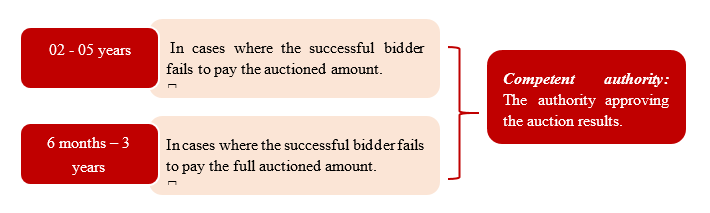
The Resolution shall cease to have effect on February 28, 2027. During the period in which the provisions of this Resolution are in force, if the regulations on advance deposits or prohibitions on participation in auctions of land use rights for residential land allocation under this Resolution differ from those in related normative legal documents, the provisions of this Resolution shall prevail.
2. New Regulations Pertaining to the Principles for Approving Capital Contributions and Share Purchases in Credit Institutions Pursuant to Circular No. 60/2025/TT-NHNN
The State Bank of Vietnam has recently issued Circular No. 60/2025/TT-NHNN (“Circular 60”), which governs the conditions, documentation and procedures for approving capital contributions and share purchases by credit institutions in other organizations and enterprises. Circular 60 shall officially take effect from 13 February 2026, replacing Circular No. 25/2024/TT-NHNN. The provisions of Circular 60 primarily amend and supplement the principles for preparing, submitting, and returning application dossiers for approval, marking a significant shift towards electronic administrative procedures and simplifying dossier components through integration with national databases, as detailed below :
(i) Formal Adoption of Online Submission of Dossiers and Return of Results
• Submission Channel: Acceptance of online submissions via the National Public Service Portal.
• Technical Requirements: Electronic dossiers must utilize digital signatures, and documents must be scanned from originals/authentic copies in PDF file format.
• Method for Returning Results: The result will be sent in electronic form when the dossier is submitted through the online method. Hard-copies shall only be issued upon a written request from the credit institution (via postal service or in person).
(ii) Reduction of Procedures Through Utilization of National Databases
The SBV shall prioritize independently retrieving enterprise information from the National Business Registration Database.
Note: Credit institutions shall additionally submit the Enterprise Registration Certificate of the entity receiving the capital contribution or share purchase in cases where the State Bank of Vietnam (SBV) is unable to access such information, or where the information available in the system is incomplete or inaccurate.
(iii) Standardization of hard-copy dossiers and translations
For dossiers submitted in hard-copy form or consisting of original documents, the new regulations tighten and clarify specific procedural requirements as follows:
• Vietnamese translations: The new regulations recognize only the form of certification of the translator’s signature, abolishing the previous requirement for notarization of translations.
• Comparison of copies with originals: Where copies are submitted together with originals for comparison, the person conducting the comparison is required to affix his/her signature directly on the copy before assuming responsibility, instead of the previous general requirement merely stating that the person shall “sign and take responsibility.”
(iv) Shortening the dossier processing time: 30 days (instead of 45 days as before) from the date of receiving a complete valid dossier, the State Bank of Vietnam or the Department of Management and Supervision of Credit Institutions will issue a written approval or non-approval of capital contribution and share purchase .
(v) Change in authority from Inspection Department to Department of Management and Supervision of Credit Institutions: The approval authority is more clearly divided, with the Governor of the SBV approving cases of capital contribution to other enterprises or converting debt into capital contribution; the Banking Supervision Department approving capital contributions and share purchases in subsidiaries or affiliates , instead of mainly belonging to the Banking Inspection and Supervision Agency as in the old regulations.
3. New regulations on personal data protection under Decree No. 356/2025/ND-CP
Decree No. 356/2025/ND-CP (“Decree 356”) has been officially promulgated and will take effect from 1 January 2026, replacing the former Decree No. 13/2023/ND-CP. Decree 356 establishes a more stringent and modern legal framework for the protection of personal privacy in the digital era. Below are the key updates that organizations should take note of to ensure compliance:
(i) Removal of the applicable subjects being Vietnamese agencies, organizations, and individuals operating abroad, and addition of the subjects being persons of Vietnamese origin whose nationality has not been determined, who are living in Vietnam and have been issued identity certificates .
(ii) One of the most notable changes lies in the expansion of the scope of personal data. Information relating to an individual’s lawful spouse is now officially classified as basic personal data , while digital behavioral data, such as telecommunications usage history and social media activity, is categorized as sensitive personal data .
(iii) In particular, in the financial and banking sector, the new regulations establish a strict protection regime for information relating to customers’ usernames, passwords, transaction histories, and credit scoring results. Credit institutions are required to publicly and transparently disclose the purposes of processing, sources of collection, and relevant related parties, and shall promptly report to the competent authorities and notify data subjects within 72 hours in the event of a leakage of sensitive personal data .
(iv) In addition to expanding the scope, Decree 356 emphasizes the consent and control of data subjects. Control is fully vested in individuals, as consent must be clearly expressed in the form of written documents, voice recordings, or active opt-in actions . The responsibility to prove the lawfulness of such consent rests with the data controller and data processor. Correspondingly, strict implementation timelines are imposed: the data controller and data processor have only 02 working days to respond to requests for withdrawal of consent or objections to data processing and from 10 to 20 days to complete procedures related to the provision, correction, or deletion of data subjects’ information .
(v) Furthermore, Decree 356, for the first time, codifies data security standards applicable to emerging technologies, including artificial intelligence systems, virtual worlds (metaverse) , blockchain technology , and cloud computing . Specifically:
• Artificial intelligence systems and virtual environments are required to ensure transparency in algorithmic principles and provide data subjects with opt-out options.
• With respect to blockchain technology, the new regulations prohibit the direct storage of personal data on-chain, permitting only the storage of hashed values or anonymized data to safeguard privacy.
• Furthermore, in an effort to professionalize the data protection market, personal data protection services are officially designated as a conditional business line, requiring organizations and individuals to obtain licensing from the Ministry of Public Security and to meet stringent requirements concerning professional qualifications and practical experience.


Anti-Bribery and Corruption Policy: LNT & Partners has issued and maintained the policy in complying with all applicable laws and regulations on bribery and corruption in Vietnam and worldwide.

