
On 31 March 2026, the Government of Vietnam issued Decree 102/2026/NĐ-CP (Decree 102), amending Decree 75/2019/NĐ-CP (Decree 75), effective from 20 May 2026.
Compared to Decree 75, Decree 102 provides greater clarity on the penalties for merger control violations, particularly for those relating to notification obligations and gun-jumping.
The key changes and their practical implications are set out below:
1. More predictable penalties and broader application for failure to Notify Economic Concentration
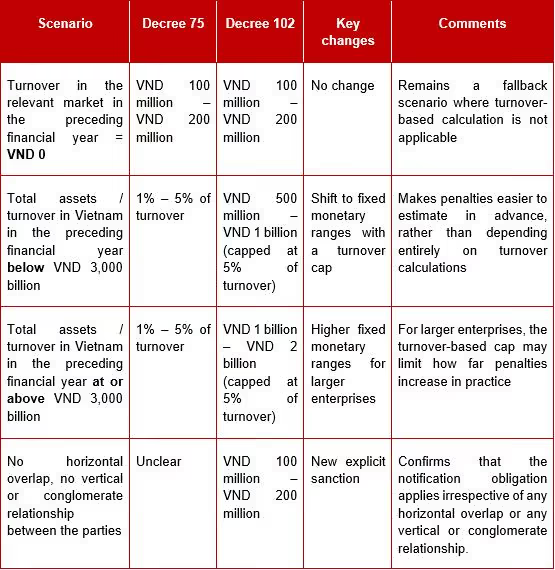
Previously, under Decree 75, penalties were generally calculated based on the violating enterprise’s turnover in the relevant market in the preceding financial year. In practice, this may lead to inconsistent outcomes, particularly where the turnover was low or difficult to determine.
Now, Decree 102 replaces this by introducing a hybrid model, which combines fixed monetary ranges with a turnover-based cap. It also confirms that notification is required regardless of whether the parties have any horizontal, vertical or conglomerate relationship. The key parameters are briefed below, our comments.
2. Gun-jumping effectively equated with failure to notify –increase in enforcement exposure
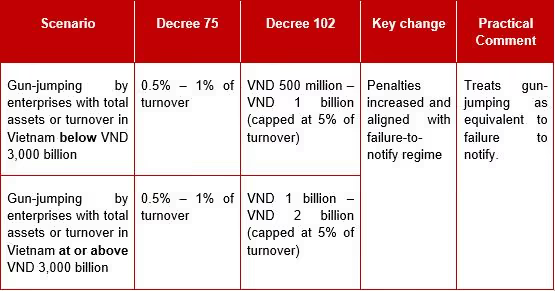
Gun-jumping (pre-clearance implementation) is now penalized at a level broadly aligned with failure to notify, briefly as follows:
Key Takeaways
• Penalties for merger control violations relating to notification obligations and gun-jumping are now more structured and easier to anticipate, with fixed ranges replacing purely turnover-based calculations.
• Gun-jumping is treated more seriously and is now closer to failure to notify in terms of penalties.
• Notification obligations continue to apply even when there is no competitive overlap between the parties.
All in all, while enhancing clarity and transparency should generally be good for enterprises’ anticipation, it may also make it practically help avoid the difficulties in determining the amount for a penalty (faced under the previous legislation), thereby likely inadvertently making it easier for applying the sanctions.


Anti-Bribery and Corruption Policy: LNT & Partners has issued and maintained the policy in complying with all applicable laws and regulations on bribery and corruption in Vietnam and worldwide.

